
For nearly three decades, Kirk Schueler has helped guide Brooks Resources through some of Central Oregon’s most significant master planning efforts. Over the course of his career, he has held several leadership roles, including Controller and Chief Financial Officer, before becoming President and CEO.
From Awbrey Butte and NorthWest Crossing to Tree Farm and Discovery West, Kirk has been part of projects that have shaped the region. In this Q&A, he reflects on Brooks Resources’ evolution, thoughtful development, and what he sees ahead for Central Oregon.
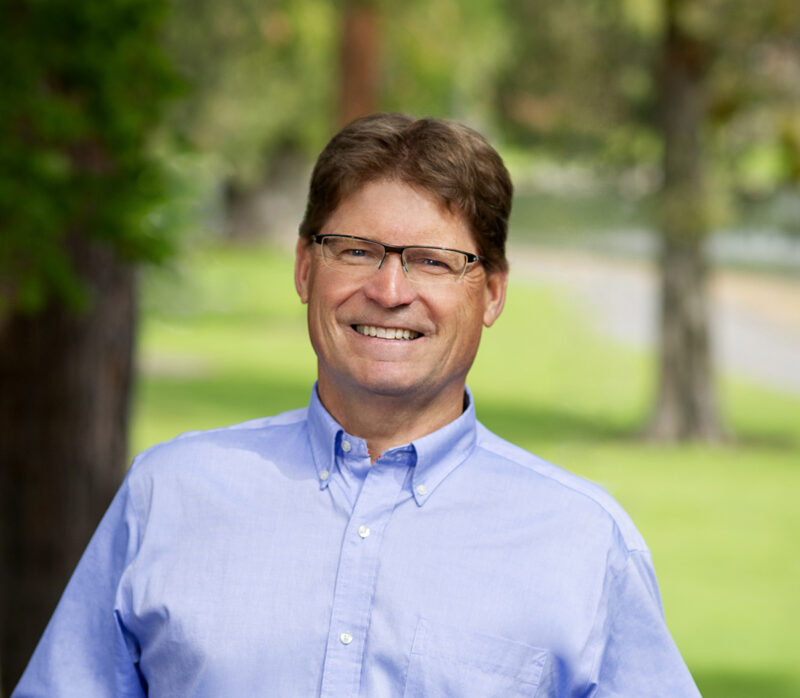
Q: Brooks Resources has been part of Central Oregon’s growth for decades. How would you describe the company’s role in the region today?
Kirk:
The company continues to develop real estate projects that reflect a commitment to quality and innovation. In that regard, after all these years, I consider the company to be a leader in developing creative solutions to serve the residential, commercial, and industrial markets.
Q: How has the company’s work evolved over the years, and what values or ideas have remained consistent?
Kirk:
I’m not sure evolved is the right word. I think the company has always followed its heart to develop projects that it could be proud of and enhance our community. I heard a saying years ago from another developer that I think sums this up: we develop projects we would want to live, work, or visit.
Q: Brooks Resources has been very successful developing master-planned communities but also works with commercial properties and development services. What’s behind this broader range of work?
Kirk:
Here is where the word evolved may be applicable. Brooks Resources was formed in 1969 and embarked on two significant resort developments, Black Butte Ranch and Mount Bachelor Village Resort. There were also a couple of rural residential subdivisions that were not based on a particular amenity package like the resort projects. Those projects led to three significant projects in Bend; Awbrey Butte, Awbrey Glen, and Shevlin Center. The first two were more traditional neighborhoods (one with a golf course amenity), and the latter an industrial park (for reference, where Deschutes Brewery is located). In the late 1990’s there was a national movement in development called “New Urbanism”. Brooks embraced this movement and created NorthWest Crossing (with a partner), IronHorse (in Prineville), Yarrow (in Madras) and Shevlin RiverFront as mixed-use master planned neighborhoods. Discovery West now follows the same approach.
With a shrinking pool of available undeveloped tracts of land in Bend to accommodate large master planned neighborhoods, Brooks Resources partnered with its longtime civil contractor, Todd Taylor and his family, to develop new campuses of commercial and industrial buildings.
This “evolution” from resorts to commercial and industrial buildings really represents Brooks Resources’ ability to adapt to the opportunities that were available and the market forces at the time.
Q: What is Brooks Resources’ process for determining the best approach for developing a project? What factors influence those decisions?
Kirk:
It really is a combination of opportunity, assumed market demand, and maybe most importantly for the people at Brooks Resources, what projects excite and inspire us.
Q: As the region grows, what do you think thoughtful development should contribute to a community beyond buildings and infrastructure?
Kirk:
I have always appreciated the term “complete neighborhoods”, which is incorporated into the City of Bend Development Code. Striving to deliver this concept provides livable and convenient places for residents. It is not an easy concept to deliver on; we have always benefited from working on large scale projects which allows for the mix of uses, open spaces, and civic institutions (schools, churches, government) to be included.
Q: When you look five or ten years ahead, what would you be excited to see Brooks Resources contribute to Central Oregon?
Kirk:
I sincerely hope that Brooks Resources will be able to secure tracts of development land that will allow it to continue its ability to deliver large mixed-use neighborhoods that add value to its residents and the larger community. Additionally, it excites me to think that our partnership with the Taylors will own and manage a significant number of commercial and industrial buildings that reflect our values of quality and thoughtfulness.
Q: Development is a long and heavily regulated process. What are your thoughts on how the city can and state governments can change policy to positively influence our community’s growth and development?
Kirk:
At the statewide level, I believe our land use laws need to be modernized. Senate Bill 100 that created Urban Growth Boundaries and statewide planning goals is a product of the mid 1970’s. At that time agriculture and forest products dominated the economy of the state. Rules were developed under that law that protected those important lands. Today, those industries, while still important, are no longer the leading sources of economic impact in our state. The leading industries are now mostly based in our urban areas. Modernization of those rules to treat all statewide planning goals equally would go a long way to ensure adequate land supply in our cities for housing and employment uses.
On a local level, I consider the City of Bend development code to be good at promoting development that serves our community well. As mentioned previously, the Bend development code embraces the concept of complete neighborhoods that can provide some of the daily needs of its residents. As Bend grows, and the scale of retail and office spaces grow, it will be challenging to keep things at a neighborhood scale. I see that as the challnge for City leaders, how to maintain neighborhood scale in new developments.
The Next Chapter of Central Oregon Development: A Q&A with Kirk Schueler
Q: Brooks Resources has been part of Central Oregon’s growth for decades. How would you describe [...]

Give a Little, Help a Local Family: Brooks Resources’ FAN Gift Card Drive
A gift card can offer a family a little extra flexibility when everyday expenses add [...]
Nov

Brooks Resources Welcomes Hannah Willard to Marketing Team
Brooks Resources Corporation is pleased to announce the addition of Hannah Willard as Marketing Events [...]
Sep

A Summer of Fun at Discovery West
Summer is in full swing at Discovery West, and Discovery Corner is shaping up to [...]
Jun

NorthWest Crossing at 25: Celebrating a Vision That Changed Bend’s West Side
Recently, members of the Brooks Resources Corporation and Tennant Development sales and development teams gathered [...]
Jun

Growth, Placemaking and Community: Reflections from ULI Spring Meeting 2026
Last month, Romy Mortensen, Brooks Resources’ VP Sales and Marketing, and I joined more than [...]
Jun

From Planner to Resident: A Conversation with Dale Van Valkenburg
For nearly 20 years, Dale Van Valkenburg has helped shape some of Bend’s most recognizable [...]
Mar

Kirk Schueler Featured on The Agency Bend Podcast
Kirk Schueler Featured on The Agency Bend Podcast Our President and CEO, Kirk Schueler, President, [...]
Mar
